An estate driveway is more than a strip of pavement connecting the street to a garage. On Long Island's Gold Coast and North Shore, the driveway is often the single largest hardscape element on the property — hundreds of feet long, engineered for heavy loads, designed to frame the home from the moment a visitor turns off the main road. It sets the tone for the entire estate. Getting it right requires an understanding of materials, scale, drainage, grading, and the architectural character of the home it serves. This guide covers everything Gold Coast homeowners need to know before starting an estate driveway project.
Why Estate Driveways Are Different
A typical Long Island residential driveway runs 30 to 60 feet from the curb to the garage. It is a functional surface — nothing more. Gold Coast estate driveways operate on an entirely different scale. Driveways in communities like Upper Brookville, Muttontown, Sands Point, and Lloyd Harbor regularly stretch 200 to 800 feet, winding through wooded lots, past stone gateposts, over grade changes, and arriving at motor courts large enough to park a dozen vehicles. The design challenges multiply with every additional foot of length.
Scale is only the beginning. Estate driveways must handle traffic that would destroy a standard residential surface. Oil delivery trucks, landscaping trailers with mowers, pool service vehicles, concrete trucks during construction, catering vans for events — all of these roll across the driveway regularly. The base preparation, material thickness, and compaction standards must account for loads that far exceed a family sedan.
Then there is the arrival sequence. Gold Coast homeowners understand that the driveway is the first design experience a visitor encounters. The journey from the entry gate to the front door should build in visual impact — starting with a clean, well-maintained surface, transitioning through material changes at key thresholds, and culminating in a motor court or turning circle that frames the home. This concept of arrival sequence design is what separates estate driveways from residential ones.
Multi-car garages, service entrances, guest parking courts, and connections to pool areas or rear patios all add complexity. Many estates have three or four separate driveway branches radiating from a central motor court, each requiring its own grading plan, drainage solution, and material transition. The driveway becomes a system, not a single surface.
Material Options for Gold Coast Driveways
Choosing the right material — or combination of materials — is the most consequential decision in estate driveway design. Each option has distinct advantages and trade-offs for Long Island's climate, soil conditions, and the demands of estate-scale use.
Asphalt with Paver Borders: The Hybrid Approach
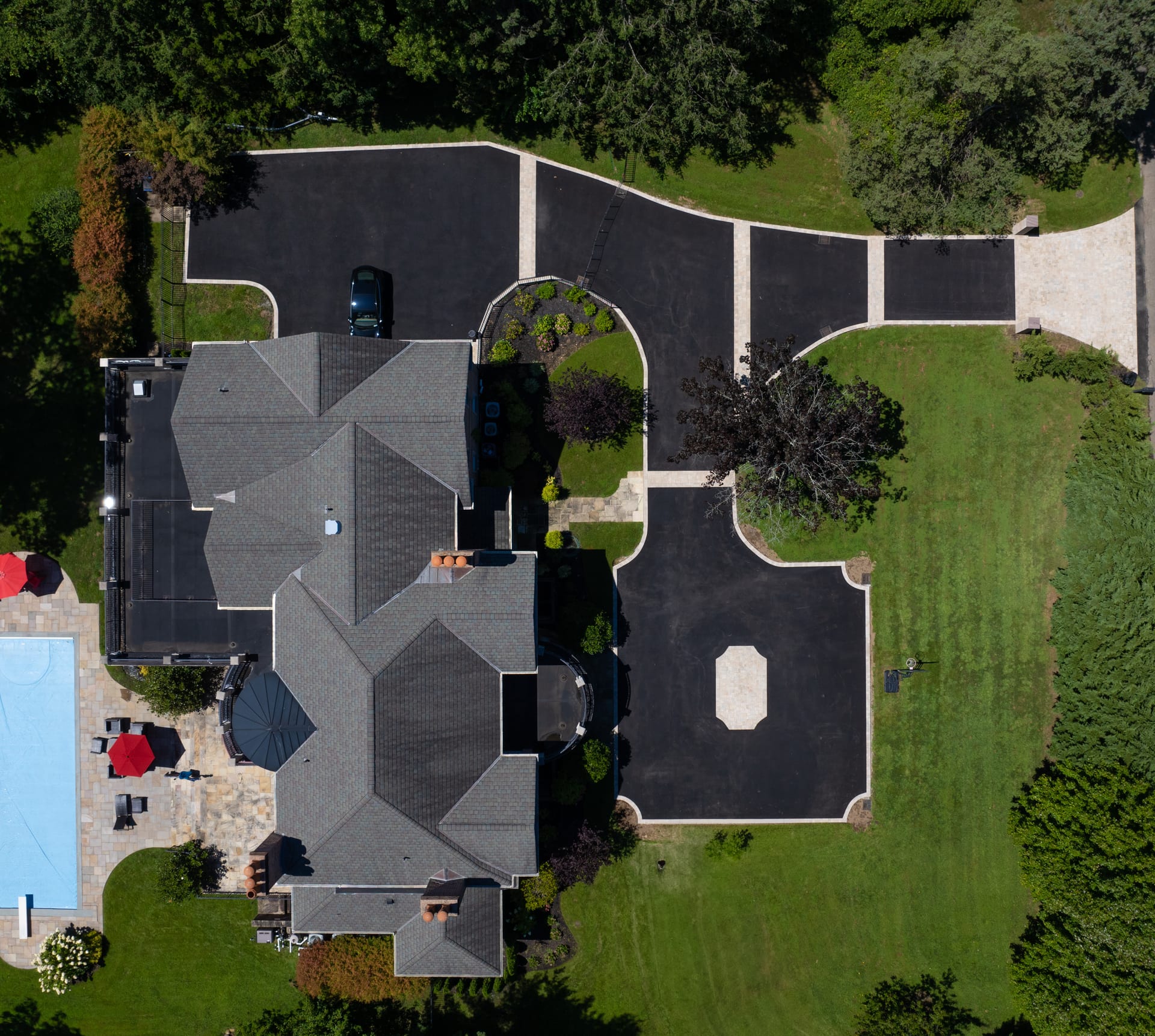
For driveways exceeding 200 feet, a full paver or stone surface can push costs past $150,000. The most popular Gold Coast strategy — and the one we used on our Lloyd Harbor estate project — is commercial-grade hot-mix asphalt for the main driveway run, bordered with pavers or Belgian block. The motor court, aprons, and the first 40 to 60 feet nearest the home are then finished in premium pavers with a decorative medallion or pattern. This approach delivers the estate aesthetic where it matters most while keeping total investment between $50,000 and $90,000 for a 400-foot driveway. The asphalt is laid in two lifts over a compacted aggregate base using the same specification as municipal roads, ensuring it handles heavy traffic without rutting or cracking.
Full Paver Driveways
Premium interlocking concrete pavers from manufacturers like Cambridge, Nicolock, Belgard, Unilock, and Techo-Bloc offer the widest range of colors, textures, and patterns. Large-format slabs in colors like Sahara Chestnut or Onyx Natural create a contemporary estate look, while tumbled styles like Cambridge Ledgestone or Nicolock Colonial recreate the appearance of hand-cut stone at a fraction of the cost. Full paver driveways typically run $20 to $40 per square foot installed, depending on the product and pattern complexity. Herringbone is the strongest pattern for vehicular use, but running bond, basketweave, and ashlar random patterns are all viable with proper base preparation. The key advantage of pavers is repairability — individual units can be lifted and replaced without patching, which is a significant benefit on Long Island where freeze-thaw cycles and tree roots can cause localized movement.
Belgian Block Driveways and Borders
Belgian block — hand-cut granite cobblestone — is the quintessential Gold Coast driveway material. It evokes the European estates that inspired the original Gold Coast mansions and ages beautifully over decades. Belgian block is extraordinarily durable, with an expected lifespan exceeding 100 years. The main trade-offs are cost ($30 to $50 per square foot installed), ride comfort (the surface is inherently textured), and installation time (hand-setting each block is labor-intensive). Many homeowners use Belgian block strategically — as motor court surfacing, driveway borders, apron transitions, or entrance features — rather than covering the entire driveway length. A Belgian block border running the full perimeter of an asphalt driveway creates a clean architectural line visible from every angle, including aerial views.
Natural Stone
Full-color bluestone, thermal-cut granite, and flagstone are premium natural stone options for estate driveways. Bluestone in particular complements the colonial, Georgian, and Tudor architecture common across the North Shore. The blue-gray tones read as timeless rather than trendy, and each piece has natural variation that concrete pavers cannot fully replicate. Natural stone driveways require a concrete or heavily compacted gravel base and periodic sealing to prevent staining and moisture penetration. Expect $30 to $55 per square foot installed, depending on stone type and cut. For most estate driveways, natural stone is reserved for the motor court and high-visibility areas near the home, with a less costly material handling the long approach.
Concrete with Decorative Finishes
Poured concrete with exposed aggregate, stamped patterns, or broom-finish borders is a functional choice that can be dressed up for estate use. Stamped concrete mimics the look of pavers or stone at a lower material cost, though it lacks the repairability of individual pavers — cracks must be patched rather than replaced. Exposed aggregate concrete shows the natural stone within the mix and provides excellent traction. On Long Island, concrete driveways are susceptible to freeze-thaw cracking if the base is not properly prepared or if control joints are spaced incorrectly. For estate applications, concrete works best as a secondary surface (service entrances, rear parking areas) rather than the primary arrival drive.
Material Comparison for Long Island Climate
- Asphalt: Best freeze-thaw flexibility, lowest cost per linear foot, requires sealcoating every 2-3 years, 15-25 year lifespan before resurfacing
- Concrete pavers: Excellent durability, individual unit replacement, wide design range, 25-40+ year lifespan with proper base
- Belgian block: Maximum longevity (100+ years), highest cost, textured ride surface, minimal maintenance
- Natural stone: Premium aesthetics, requires sealing, moderate freeze-thaw risk if poorly installed, 30-50+ year lifespan
- Poured concrete: Moderate cost, crack risk in Long Island winters, limited repairability, 20-30 year lifespan
Design Elements That Define Estate Driveways
Material selection is only half the equation. The design elements layered onto and around the driveway surface are what elevate a functional path into an estate-worthy arrival experience.
Paver Medallions and Motor Court Centerpieces
A paver medallion is a decorative inset — typically diamond-shaped, circular, or in a custom geometric pattern — installed at the center of the motor court. It serves the same function as a foyer in a home: it announces arrival and sets the architectural tone. In our Lloyd Harbor estate project, the diamond-shaped paver medallion is the visual anchor of the entire driveway system, visible from every approach and striking in aerial drone photography. Medallions are built with premium pavers in contrasting colors and patterns, set within a defined border that separates them from the surrounding field. They typically add $3,000 to $8,000 to a project depending on size and complexity, but the visual impact far exceeds the cost.
Aprons and Material Transitions
Aprons are the transitional zones where one material meets another — where asphalt meets pavers at the motor court entrance, where the driveway meets a walkway, or where the main drive branches toward a garage wing. Well-designed aprons create deliberate visual breaks that signal a change in zone. On estate driveways, every transition point should be treated as a design opportunity. The apron width, paver pattern, and color selection should complement both adjacent surfaces. A 4-foot paver apron at the street entrance, for example, creates a premium first impression even when the main driveway surface is asphalt.
Border Treatments
Borders run along the driveway perimeter and serve both structural and aesthetic functions. Structurally, they provide permanent edge restraint that prevents asphalt edge deterioration and holds paver fields in place. Aesthetically, they create a clean architectural line that defines the driveway from every angle. Common border treatments include soldier course (pavers set end-to-end in a single row), double borders with contrasting colors, Belgian block borders against asphalt, and natural stone edging. On estate driveways where the surface meets lawn on both sides for hundreds of feet, unbordered edges are the first thing to fail — and the first thing guests notice.
Landscape Lighting Integration
A grand driveway disappears after dark without lighting. Low-voltage LED landscape lighting installed along the driveway perimeter highlights borders, illuminates medallions, marks grade transitions, and provides safety at curves and intersections. Path lights, bollard lights, and in-ground uplights aimed at gateposts or specimen trees are the most common driveway lighting elements. The system should be designed on a timer or photocell for automatic operation. Lighting extends the visual impact of the driveway to evening hours and adds a security element that Gold Coast homeowners expect. Modern LED systems are energy-efficient and designed for years of maintenance-free operation.
Drainage Engineering for Long Driveways
Long driveways collect enormous water volume during storms. A 400-foot driveway that is 16 feet wide creates over 6,400 square feet of impervious surface — enough to generate hundreds of gallons of runoff in a moderate rain event. Without proper drainage, water sheets toward the home, erodes the driveway base, pools in low spots, and can undermine adjacent landscaping. Trench drains at the motor court, French drains along the driveway edges, catch basins at low points, and dry wells for volume management are all standard components of estate driveway drainage systems. In low-lying coastal communities like Bayville and Centre Island, drainage engineering is often the most complex phase of the project.
Grade Management and Retaining Walls
Gold Coast properties are rarely flat. Driveways often navigate 10 to 30 feet of elevation change between the street and the home, and the North Shore's glacial terrain creates slopes, ridges, and depressions that must be addressed. Proper grading ensures water flows to designed collection points while maintaining a comfortable driving surface (ideally 2-5% cross-slope for drainage, with longitudinal grades under 10% for safe winter use). Where grade changes are too steep for a smooth driveway slope, retaining walls provide structural support and create level terraces. Retaining walls along estate driveways are typically built with natural stone or architectural block to complement the driveway materials and the home's facade.
What Gold Coast Homeowners Should Expect
Typical Project Timeline
Estate driveway projects move through distinct phases, and understanding the timeline prevents frustration. Site clearing and grading typically take 3 to 5 days for a standard estate lot. Base preparation — excavation, aggregate installation, and compaction — requires another 3 to 7 days depending on driveway length and soil conditions. Asphalt paving can often be completed in 1 to 2 days for the main run. Paver installation for aprons, medallions, and borders adds 1 to 3 weeks depending on scope. Masonry elements and retaining walls add 1 to 2 weeks. Landscape lighting installation typically runs concurrently with other phases. Total project duration ranges from 2 weeks for a straightforward asphalt-with-borders installation to 6 weeks or more for a full estate transformation with multiple materials, masonry, and lighting.
Cost Ranges for Estate Driveway Systems
Estate driveway costs vary significantly based on length, material selection, site conditions, and the scope of ancillary work (drainage, grading, masonry, lighting). Based on our experience across Gold Coast communities, here are realistic ranges:
- Asphalt driveway with paver borders (200-400 feet): $30,000 - $60,000
- Asphalt driveway with paver aprons, medallion, borders, and lighting (300-600 feet): $60,000 - $100,000
- Full paver driveway with motor court (100-300 feet): $45,000 - $90,000
- Belgian block motor court with asphalt approach: $50,000 - $85,000
- Complete estate transformation — clearing, grading, asphalt, pavers, masonry, drainage, lighting: $80,000 - $150,000+
- Natural stone motor court and driveway (under 200 feet): $60,000 - $120,000
These ranges assume standard Long Island soil conditions. Properties with significant rock, wetland setbacks, or extreme grade changes may exceed these estimates. We provide detailed, itemized proposals after an on-site consultation so there are no surprises. Request a free estimate to get accurate pricing for your property.
Permitting Considerations in Gold Coast Villages
Every Gold Coast village has its own building department, zoning code, and site plan requirements. Some villages require permits for any driveway wider than 12 feet. Others have impervious surface coverage limits that restrict the total area of paved surface on a lot — this can affect material choices, as permeable pavers may be required in environmentally sensitive zones near harbors, wetlands, and coastal areas. In communities like Centre Island, Cove Neck, and Matinecock, there may be architectural review board processes for visible site improvements. Lloyd Harbor and Cold Spring Harbor have specific setback and grading requirements. We handle all permitting, survey coordination, and village compliance as part of every estate project.
How to Evaluate Contractors for Estate Driveway Work
Estate driveway projects demand a contractor with specific capabilities that go beyond standard residential paving. When evaluating contractors, look for:
- A portfolio of completed estate driveways — not just residential work. Ask to see projects over 200 feet with multiple material transitions.
- Access to commercial-grade equipment: full-size pavers, large rollers, skid steers, and grading equipment that can handle estate-scale earthwork.
- Knowledge of local village permitting processes and relationships with building departments across the Gold Coast.
- Relationships with premium material suppliers — Cambridge, Nicolock, Belgard, Unilock, Techo-Bloc, and natural stone yards.
- Proper insurance coverage for high-value properties, including general liability of at least $2 million and workers' compensation.
- References from Gold Coast homeowners who can speak to the contractor's professionalism, communication, and finished quality.
- In-house design capability for medallions, motor courts, and material transitions — not just installation.
Gold Coast Communities We Serve
Brothers Paving & Masonry has completed estate driveway and hardscape projects across every Gold Coast community on Long Island's North Shore. Each town has its own character, lot sizes, architectural styles, and permitting requirements — and we bring local knowledge to every project. We serve Upper Brookville, Kings Point, Matinecock, Sands Point, Old Brookville, Muttontown, Centre Island, Cold Spring Harbor, Lloyd Harbor, Lattingtown, Mill Neck, Locust Valley, Oyster Bay, Manhasset, Great Neck, Roslyn, Brookville, Bayville, Sea Cliff, and Huntington Bay.
Whether your property is a waterfront estate in Sands Point, a wooded compound in Old Brookville, or a North Shore colonial in Manhasset, the driveway design principles are the same: right materials, proper engineering, and design that matches the stature of the home. The specific execution changes with every property, and that is where experience matters.
See Our Work
Our Lloyd Harbor Gold Coast estate project is the best example of everything in this guide put into practice. A multi-acre North Shore property featuring a complete asphalt driveway system with paver aprons, a custom decorative medallion at the motor court, paver borders along the full perimeter, structural masonry at grade transitions, and a low-voltage landscape lighting system — all documented with professional drone photography and a multi-part video series. Visit the project page to see drone aerials, before-and-after details, and the full scope breakdown.
Explore our full portfolio of Gold Coast estate projects or browse our driveway services and paver patio services to see the range of work we deliver across Long Island.
Start Your Estate Driveway Project
Brothers Paving & Masonry brings the equipment, design capability, and Gold Coast experience that estate-scale driveway work demands. From initial consultation through permitting, material selection, installation, and final walkthrough — we manage every phase. We have built driveways in every North Shore community from Great Neck to Cold Spring Harbor, and we bring that local knowledge to every project. Contact us for a free on-site consultation and see why Gold Coast homeowners trust Brothers Paving for their most important hardscape investments.