
Table of Contents
A new driveway on Long Island costs between $4,200 and $42,000 depending on material. Asphalt: $7-$15/SF. Concrete: $12-$25/SF. Pavers: $20-$35/SF. Belgian block: $30-$70/SF. Brothers Paving & Masonry has installed driveways across all 148 Nassau and Suffolk County towns with 70+ five-star reviews over 15 years.
How Much Does a Driveway Cost on Long Island?
A new residential driveway on Long Island in 2026 ranges from $4,200 on the low end (small asphalt) to $42,000+ on the high end (large paver or Belgian block). The price is fully loaded — it includes demo of the existing surface, hauling, base preparation, the surface material itself, edge details (Belgian block, soldier course borders), apron coordination with the town, and final inspection. The four mainstream materials cluster into clean per-square-foot ranges that we use for early estimating.
Asphalt
$7–$15/sf
The default Long Island driveway material. Lowest upfront cost, fast install, 20-30 year lifespan with proper maintenance. Ideal for budget-conscious homeowners and longer driveways where total square footage matters.
Concrete
$12–$25/sf
Clean modern look. 25-40 year lifespan when proper control joints and reinforcement are used. Cracks under freeze-thaw cycles are inevitable but manageable. Best on flat lots with good drainage.
Paver Driveway
$20–$35/sf
The premium choice for Long Island. 30-50+ year lifespan, individual unit replacement, lifetime manufacturer warranty on Cambridge, Nicolock, Belgard, and Techo-Bloc pavers. The standard tier on the Gold Coast.
Belgian Block
$30–$70/sf
Granite cobbles set in concrete. Most often used as borders and aprons combined with asphalt or paver fields. Full Belgian block driveways are a Gold Coast statement piece — 50-100+ year lifespan, unmatched curb appeal.
Driveway size examples (2026 pricing)
Long Island residential driveways range from short single-car runs (300-400 SF) to long estate driveways (3,000+ SF). The ranges below cover the realistic middle of the market.
- 600 SF driveway (typical short single-car) — Asphalt $4,200-$9,000. Concrete $7,200-$15,000. Pavers $12,000-$21,000. Belgian block $18,000-$42,000.
- 900 SF driveway (standard 2-car with apron) — Asphalt $6,300-$13,500. Concrete $10,800-$22,500. Pavers $18,000-$31,500. Belgian block $27,000-$63,000.
- 1,200 SF driveway (2-car with turnaround) — Asphalt $8,400-$18,000. Concrete $14,400-$30,000. Pavers $24,000-$42,000.
- 2,000+ SF driveway (estate, long approach) — Asphalt $14,000-$30,000. Concrete $24,000-$50,000. Pavers $40,000-$70,000+. Belgian block accent strips and apron typically add $8,000-$20,000.
For the deepest material-specific pricing breakdowns, see our asphalt driveway cost guide, concrete driveway cost guide, paver driveway cost guide, and the master driveway cost on Long Island breakdown. For square-foot-level asphalt math, the asphalt paving cost per square foot guide walks through every variable.
Driveway Materials Compared
Material selection is the single biggest decision in a Long Island driveway project. The four mainstream choices — asphalt, concrete, pavers, and Belgian block — each excel in a different combination of cost, appearance, durability, and freeze-thaw performance. After 15 years building driveways across Nassau and Suffolk we can summarize how each material actually performs in our local climate, on our typical lot grades, and against the realistic budgets homeowners bring to the table.
Asphalt driveways
Asphalt is the most-installed driveway material on Long Island, and for good reason. It is the lowest cost mainstream option, installs in 2-3 days, and handles freeze-thaw cycles better than concrete because the binder remains slightly flexible. The standard Long Island asphalt driveway is a two-lift install — a 2 to 3 inch binder course (larger aggregate, structural strength) topped with a 1.5 to 2 inch top course (finer aggregate, smooth black finish). Total compacted asphalt thickness runs 3.5 to 5 inches over 6 inches of compacted RCA base.
Asphalt's weaknesses are visual (it's plain black), maintenance (it benefits from sealcoating every 3-5 years), and longevity (20-30 years with maintenance, vs. 30-50 for pavers). The most common failure mode is edge raveling — small stones loosening from unsupported driveway edges where lawn meets asphalt. Belgian block borders solve this completely and add resale appeal.
Concrete driveways
Concrete driveways have a clean, modern, monolithic look that works particularly well on contemporary homes. A properly installed Long Island concrete driveway is a 4 to 6 inch slab with #4 rebar or wire mesh reinforcement, control joints cut every 8 to 10 feet to manage cracking, and a broom or stamped finish. Concrete carries a 25 to 40 year lifespan and offers the cleanest aesthetic of any monolithic driveway material.
The challenge in our climate is that concrete is rigid. Long Island sees 30 to 50 freeze-thaw cycles per winter, and that thermal cycling will produce cracks over time — control joints help direct where they form but don't eliminate them. De-icing salt also causes surface spalling on standard concrete. We typically recommend calcium chloride or sand for de-icing on concrete driveways instead of rock salt.
Paver driveways
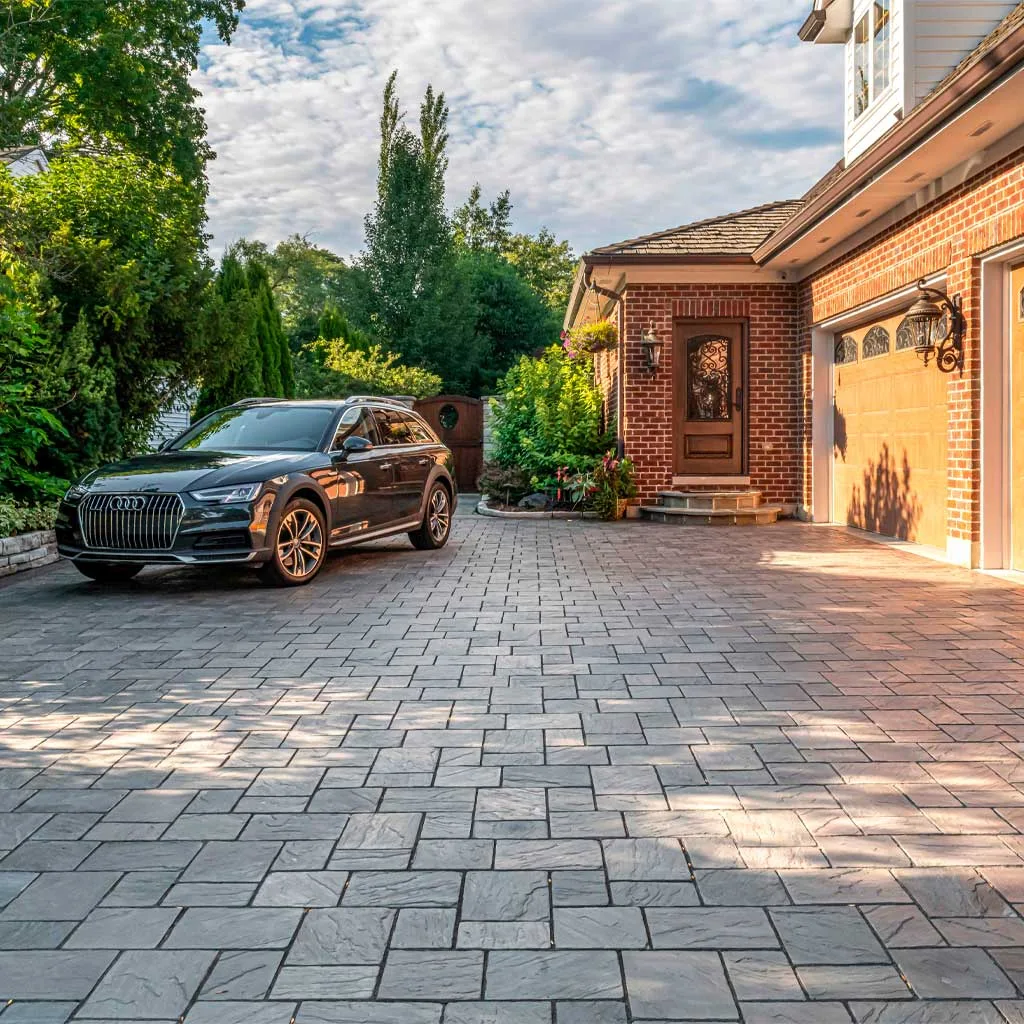
Paver driveways are the premium tier of Long Island residential driveway construction. Concrete pavers from Cambridge, Nicolock, Belgard, and Techo-Bloc are manufactured under high pressure with through-color pigments, carry lifetime limited warranties on the units themselves, and handle freeze-thaw cycles better than any monolithic material because each unit moves independently. A paver driveway requires deeper base prep (8 to 10 inches of compacted RCA minimum) and a herringbone or modular pattern for vehicular load capacity.
Cambridge and Nicolock are the two most-installed paver brands for Long Island driveways. Cambridge ArmorTec and Nicolock Paver-Shield both seal the unit during manufacturing — neither requires field sealing for stain or fade protection. Nicolock is manufactured in Lindenhurst, NY (about 8 minutes from our Bay Shore yard), which gives us the shortest lead times on the island. Belgard's large-format Mega-Arbel and Techo-Bloc's Industria series round out the Premium tier for European-styled driveways. For pattern selection, herringbone at 45 degrees is the structurally superior choice for any vehicular surface.
Belgian block
Belgian block — granite cobbles roughly 4x4x9 inches — is the historic Long Island driveway material that has become a status signal on the North Shore and Gold Coast. Solid Belgian block driveway fields are rare due to cost ($30-$70/SF) and the rough ride; the more common application is Belgian block borders and aprons combined with an asphalt or paver field. A Belgian block apron at the curb wears better than asphalt or concrete, looks unmistakably high-end, and protects driveway edges from snowplow damage. Most full-Belgian-block driveways we build today are restoration or new construction projects on Lloyd Harbor, Cold Spring Harbor, Old Westbury, and Sands Point estates.
Deep-dive material comparisons:
Asphalt vs. Concrete vs. Paver Driveways
Most Long Island homeowners narrow the decision down to two of these three materials. The right answer depends on lot size, budget, home style, neighborhood norms, and how long the homeowner expects to stay in the house. Below is the head-to-head we walk clients through on every estimate.
Asphalt vs. concrete
Asphalt wins on cost ($7-$15/SF vs. $12-$25/SF), install speed (2-3 days vs. 3-5 days plus 7-day cure), and freeze-thaw flexibility. Concrete wins on aesthetic, longevity, and the ability to be stamped or colored. For a typical 600-1,000 SF Long Island driveway, asphalt is the practical choice unless the home design specifically calls for concrete's clean lines (modern, minimalist, contemporary architecture).
Read the full comparison: Asphalt vs. concrete driveway on Long Island.
Asphalt vs. pavers
Pavers are the premium upgrade over asphalt — better appearance, longer lifespan, easier repair, higher resale value. Pavers cost roughly 2 to 3 times more upfront but typically last 1.5 to 2 times longer. The decision usually comes down to budget and how long the homeowner plans to stay. If you are in your forever home, pavers pay back over the life of the driveway. If you are mid-tenure, the math gets more nuanced.
Full comparison: Asphalt vs. paver driveway: which is right for your Long Island home.
Pavers vs. concrete
Pavers outperform concrete on freeze-thaw, repair, and resale on Long Island. Concrete wins on initial cost (roughly 50-70% of the paver price) and on a clean monolithic aesthetic for modern homes. The tiebreaker for most clients is the cracking question — concrete will crack over a 25 to 40 year lifespan in our climate; pavers will not. For homes worth over $1.5M on the North Shore, pavers are the clear standard.
Full comparison: Paver driveway vs. concrete driveway on Long Island.
The Installation Process
Every driveway Brothers Paving & Masonry installs follows the same 8-step build process. The sequence is non-negotiable. We have been called to repair too many failed driveways over the years where a previous contractor skipped one of these steps — usually base depth or compaction — to save a day or a few dollars. The savings are always paid back tenfold when the driveway fails 5 to 8 years later.
- 1
Site evaluation and design
A senior installer walks the property, measures the driveway footprint, evaluates drainage and grade, identifies the apron transition, locates utility lines, and confirms material selection. We produce a written scope of work specifying base depth, course thickness, edge details, and apron specifications. Driveway widths, turnaround radii, and parking pad dimensions are confirmed with the homeowner before any equipment is mobilized.
- 2
Permits and utility marking
Most Long Island towns require a building permit and street opening permit for new driveways or apron replacement. We file with the local building department and coordinate with town inspectors. We always call 811 to mark utility lines before any digging — gas, water, electrical, irrigation, and cable lines all need to be located. Permit lead times run 1 to 4 weeks depending on the town.
- 3
Demo and excavation
Existing asphalt, concrete, or paver surfaces are removed and hauled off site. We then excavate to a depth of 10 to 14 inches below finished grade for asphalt and concrete driveways, and 12 to 16 inches for paver driveways. Excavation depth accounts for full base depth plus the surface course. We grade for proper drainage — typically 1/4 inch per foot of fall away from the house.
- 4
Sub-base preparation
This is the single most important step in driveway construction. We install 6 to 10 inches of compacted RCA (recycled concrete aggregate) or 3/4 inch crushed stone in 2-inch lifts, compacting each lift with a 5,000 lb plate compactor or roller. For paver driveways, base depth runs 8 to 10 inches minimum because of the live load from vehicles. Skipping base depth or skipping compaction is the number one cause of driveway failure on Long Island.
- 5
Asphalt: binder and top course (or concrete pour, or paver bedding)
For asphalt driveways, we install a 2 to 3 inch binder course (larger aggregate, structural strength) followed by a 1.5 to 2 inch top course (finer aggregate, smooth finish) — total compacted asphalt thickness of 3.5 to 5 inches. For concrete driveways, we form, place rebar or wire mesh reinforcement, pour 4 to 6 inch slab thickness, and finish with broom or stamped texture. For paver driveways, we screed a 1-inch bedding sand layer over the compacted base.
- 6
Compaction or curing
Asphalt is compacted with a 5,000 to 10,000 lb roller in multiple passes while the mix is still hot — this seats the aggregate and produces the dense, smooth surface. Concrete is finished, control joints cut at 8 to 10 foot intervals, and cure compound applied; cure time is 24 hours before foot traffic and 7 days before vehicle traffic. Paver driveways receive final plate compactor passes after pavers are laid and joint sand is swept.
- 7
Belgian block borders and aprons
Belgian block borders are set in concrete along driveway edges, between asphalt and lawn or between paver field and curb. Belgian block aprons (the transition from street to driveway) are a Long Island classic that signals quality and protects the driveway edge from snowplow damage. Aprons are tied into the town curb according to local specifications and inspected by the town before final paving.
- 8
Sealing, joint sand, and final inspection
New asphalt driveways are not sealcoated for the first 6 to 12 months — the binder needs to fully cure first. Concrete driveways are sealed 30 to 60 days after pour to allow efflorescence to discharge. Paver driveways receive polymeric joint sand and a final compaction pass. We walk the finished driveway with the homeowner, document with photos, and schedule any required town inspection. The job is not complete until inspection passes.
Step 4 — sub-base preparation — decides the entire long-term performance of the driveway. A driveway installed on 4 inches of base will fail; a driveway installed on 8 inches of compacted RCA in 2-inch lifts will outlast the homeowner's ownership of the property. Ask any contractor you interview to specify in writing the base depth, base material, and compaction lift schedule.
More installation detail:
Maintenance & Lifespan
Driveway lifespan varies significantly by material — and by maintenance. The numbers below assume a properly installed driveway with correct base depth and routine seasonal care. A driveway installed on inadequate base will fail well before the lower bound regardless of how diligent maintenance is.
- Asphalt: 20 to 30 years with crack filling and periodic sealcoating. Expect to sealcoat every 3 to 5 years and to crack-fill any visible joints annually. Edge raveling is the most common early failure mode.
- Concrete: 25 to 40 years. Cracks are inevitable on Long Island; control joints direct where they form. Optional sealing every 3-5 years protects against staining and de-icing salt damage.
- Paver driveways: 30 to 50+ years. Polymeric joint sand refresh every 5 to 10 years. Cambridge ArmorTec and Nicolock Paver-Shield never need surface sealing.
- Belgian block: 50 to 100+ years. Joint mortar repointing every 15 to 25 years. The most durable mainstream driveway material on Long Island.
Winter care on Long Island
Winter is hard on every driveway material. Snow plowing damages edges (especially asphalt without Belgian block borders), de-icing salt corrodes concrete and accelerates surface spalling, and ice dam runoff can cause base erosion. The two most important winter rules: use a plow blade with rubber edges or skis to avoid gouging, and use calcium chloride or sand instead of rock salt on concrete. Pavers handle salt without damage; asphalt is salt-tolerant; concrete is the most vulnerable material.
More maintenance guides:
Driveway Aprons & Permits on Long Island
The driveway apron is the section between the road or curb and your property line. On Long Island, the apron is typically owned by the town or village and is subject to specific construction standards. When you install a new driveway, the apron almost always needs to be replaced too — old aprons rarely match new driveway grade or material, and most towns will not pass final inspection without a properly tied-in apron.
Apron replacement requires a separate street opening permit in most Long Island towns. The Towns of Hempstead, Babylon, Islip, Huntington, Oyster Bay, North Hempstead, Smithtown, and Brookhaven each have their own apron specifications — slope requirements, transition radii, and acceptable materials. Some towns require concrete aprons regardless of the driveway material; others permit asphalt or paver aprons as long as they meet grade and slope specs. We pull every required permit and coordinate every inspection.
Incorporated villages — Garden City, Manhasset, Lloyd Harbor, Sands Point, Old Westbury, Cold Spring Harbor — have their own building departments separate from the town and often have stricter aesthetic review requirements. Belgian block or paver aprons are common requirements in these villages.
Permit lead times run 1 to 4 weeks for standard residential driveways, longer for villages with aesthetic review boards. Brothers Paving & Masonry has working relationships with most Nassau and Suffolk building departments — we know where the friction points are and how to navigate them efficiently.
Full town-by-town apron reference: Driveway apron paving guide for Long Island. For curb appeal upgrades that pair driveway and walkway work, see our coordinated upgrade guide.
Town-Specific Driveway Pricing
Driveway pricing on Long Island varies by town due to three factors: lot size and driveway length (estate driveways scale very differently from short suburban driveways), material tier expectation (Gold Coast clients select pavers or Belgian block as a default), and access logistics (gated communities, narrow approaches, long material walks, and aesthetic review boards). The realistic 2026 ranges by tier are below.
Gold Coast (Ultra-Premium)
Old Westbury, Manhasset, Sands Point, Lloyd Harbor, Cold Spring Harbor, Lattingtown, Mill Neck, and Kings Point operate almost exclusively in the paver-driveway and Belgian-block tier. Driveways routinely exceed 2,000 SF (often 3,000-5,000 SF for true estate properties), with full Belgian block borders, decorative paver fields in herringbone or modular blend, integrated motor courts, and coordinated walkways. Typical project budgets run $40,000 to $150,000+. For estate-grade design specifically, see our estate driveway design guide and Gold Coast estate driveway design guide.
Premium suburban
Garden City, Syosset, Jericho, Huntington, Dix Hills, Commack, Smithtown, and similar premium-suburban towns cluster in the asphalt-with-Belgian-block-border or full paver tier. Lot sizes support 800 to 1,500 SF driveways with curves, turnarounds, and parking pads. Project budgets typically run $12,000 to $45,000.
Mid-tier suburban
Babylon, Massapequa, Bay Shore, Patchogue, Levittown, and similar mid-tier South Shore and central towns trend toward asphalt with optional Belgian block accent strips. Lot sizes commonly support 500 to 900 SF driveways. Project budgets typically run $5,500 to $15,000.
We service all 148 towns across Nassau and Suffolk County. For our complete driveway service area, see the driveway paving hub page.
Why Choose Brothers Paving & Masonry
Brothers Paving & Masonry is a family-built hardscape contractor based in Bay Shore, NY. We have operated on Long Island for 15+ years, built more than 1,628 documented projects across all 148 towns in Nassau and Suffolk County, and earned 70+ five-star Google reviews from homeowners we have worked with. Every driveway is run by a Brothers crew — we do not subcontract installation work.
- ✓15+ years on Long Island. We have weathered every market cycle, every freeze, and every spring rush since the company was founded.
- ✓70+ five-star Google reviews. Every review is from a verified Long Island homeowner. We respond to every review within 24 hours.
- ✓All 148 Nassau & Suffolk towns. If you are in Nassau or Suffolk County, we have likely installed a driveway within 5 minutes of your home.
- ✓Cambridge and Nicolock certified installer. Manufacturer certification is required for the lifetime paver warranty to apply.
- ✓Licensed and insured in Nassau and Suffolk. Full liability coverage and workers' compensation. License numbers and certificates of insurance available on request.
- ✓Permits and apron coordination handled. We pull every required permit and coordinate every town inspection — homeowners do not chase paperwork.
- ✓5-year workmanship warranty. On top of the manufacturer lifetime warranty on pavers and the natural lifespan of properly installed asphalt and concrete.
Want to know more? Read our story, read our customer reviews, or browse our project gallery.
Frequently Asked Questions
The questions Long Island homeowners ask us most often before signing a driveway contract. If your question isn't answered here, call us at (631) 374-9796 or request a free estimate.